
The Hidden Symbolism in Egyptian Glass Art
In Cairo, ornament was never only decoration. The patterns carved into a mosque wall or pierced into a wooden screen were a language — about light, about geometry, about what a city believed.
MISHKAH borrows that language directly. Every form we blow is named for something that already stands in the old city.
The mashrabiya — the screen that filters light
Old Cairo built wooden lattice screens across its windows: privacy from the street, and a way to break harsh sun into something soft and patterned.
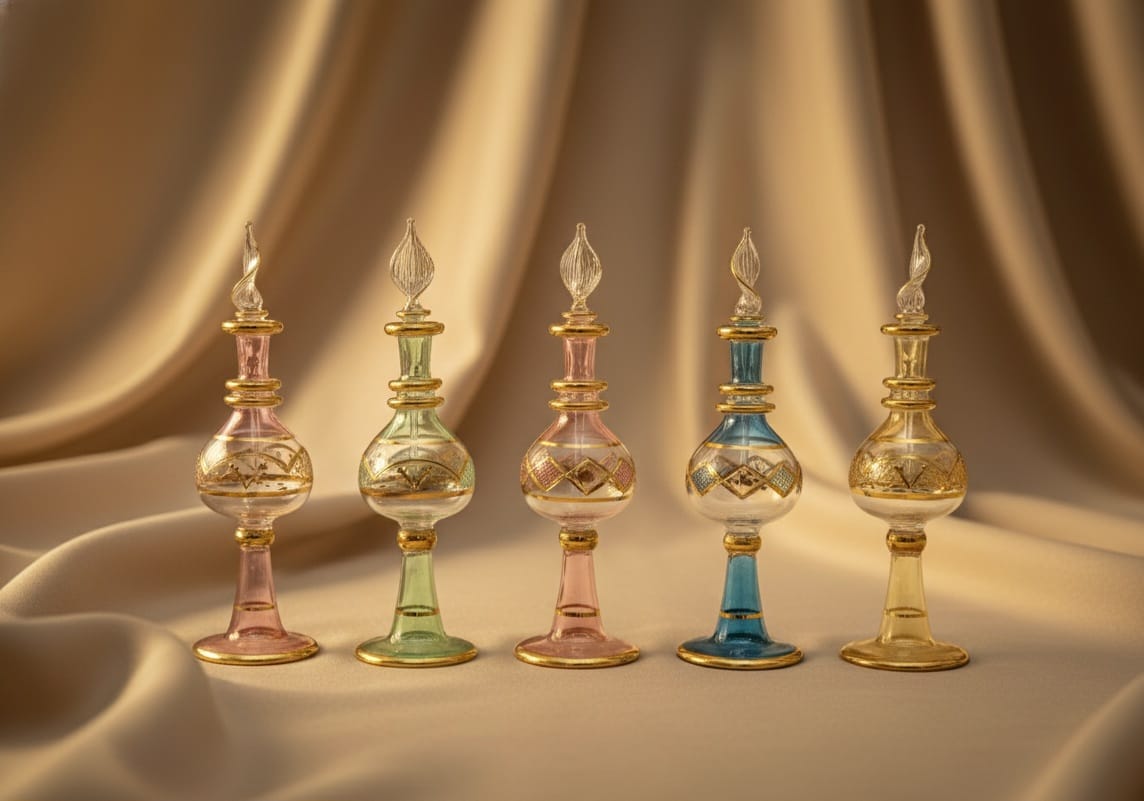
We render that lattice in gold, applied by hand around the glass, mesh by mesh, while the piece turns. What the screen did for a room, the gold does for the light inside the vessel.
The shamsa — the sunburst
On the facade of the Al-Aqmar mosque, a pierced medallion has scattered sunlight down al-Muizz Street since 1125. The Egyptians called it a shamsa — a little sun.
It appears in our work twice: as hand-placed rosettes with gilded centres, and as a radiating disc blown into a bottle with a jewel at its heart.
The qubba — the dome
Cairo's skyline is a conversation between domes. Stacked in glass, the same curve becomes a candlestick — and at a smaller scale, an ornament for a tree.
The muqarnas — the honeycomb vault
Above the gates of the old city, stone is corbelled into cells that step downward like a honeycomb. It is the most mathematical thing in Islamic architecture, and the hardest to translate into glass. We stack discs to suggest it.
The tiraz — the band of honour
Fatimid workshops embroidered bands onto robes to name the rank of the wearer. We crimp ribbons of glass by hand, gild them, and fire them in. The glass remembers the tool.
Why the names matter
A vessel with a borrowed name is not a costume. It is a way of saying where a thing comes from, and of keeping a vocabulary alive that would otherwise only survive in books.
Every piece we make carries one of these words. It is printed on the page, and it is the first thing we teach a new artisan.
MISHKAH · hand-blown in Cairo, finished in fired 24K gold.