
Our Story
OUR STORY
A niche of light, kept burning since 1985.
A mishkah is the niche that holds a lamp — the recess cut into a wall of the old city, where a single flame was set to light an entire room. It is the oldest lighting technology Cairo has, and it is the whole idea behind this house: take one small light, and give it back to the room amplified.
This is how we came to make it.
The furnace
Our atelier opened in Cairo in 1985 and has not gone cold since. It began the way most workshops in this city begin — one furnace, a few pairs of hands, and work sold to whoever walked in.
What was made there was very good. Rods of borosilicate drawn out over a flame past a thousand degrees, shaped without moulds, by breath and by timing. The technique had come down through the workshops of Cairo across a thousand years, hand to hand, the way craft moves in a craft city — never written down, never fully interrupted.
The gap
And yet, for most of the last century, "Egyptian glass" meant something else entirely: a thin souvenir on a bazaar shelf, priced to be haggled over and forgotten on the flight home.
The skill had survived. The standing had not.
That gap — between what our artisans could actually do and what the world believed Egyptian glass was worth — is the reason MISHKAH exists.
The decision
We did not change how the glass is made. There was nothing to fix.
We changed everything around it. We stopped making anonymous stock and started making named pieces — each form drawn from something that already stands in this city, and called by its right name: mashrabiya, shamsa, qubba, muqarnas, tiraz, sabil. We finished them in real 24-karat gold, fired into the glass in the kiln, because that is what Cairo always did before it was told to cut corners. We packed them to survive an ocean, and insured them to the door.
The same hands. The same furnace. Held to the standard the work always deserved.
The hands
Every piece that leaves this atelier was shaped by a person, at a flame, in one continuous act of attention that cannot be paused or undone. There are no moulds here and no machines — only glassblowers who have spent years learning what molten glass intends to do a half-second before it does it.
This is why no two of our pieces are identical, and why we have never wanted them to be. A faint bubble, a wall a shade thicker on one side, a gold band that sits a millimetre differently — these are not flaws to be apologised for. They are the record of the breath that made the piece, and the signature of the person who made it.
The gold
The gold is not paint and not plating. It is true 24-karat, applied by hand and then fired into the surface in the kiln, so that glass and gold become a single body. Washed kindly, it will outlast everyone reading this.
What we are building
MISHKAH is a small house with an unfashionably long horizon. We are not trying to make a great deal of glass. We are trying to put Egyptian glass back where it stood a thousand years ago — in the rooms, on the tables and behind the counters of people who know exactly what they are looking at.
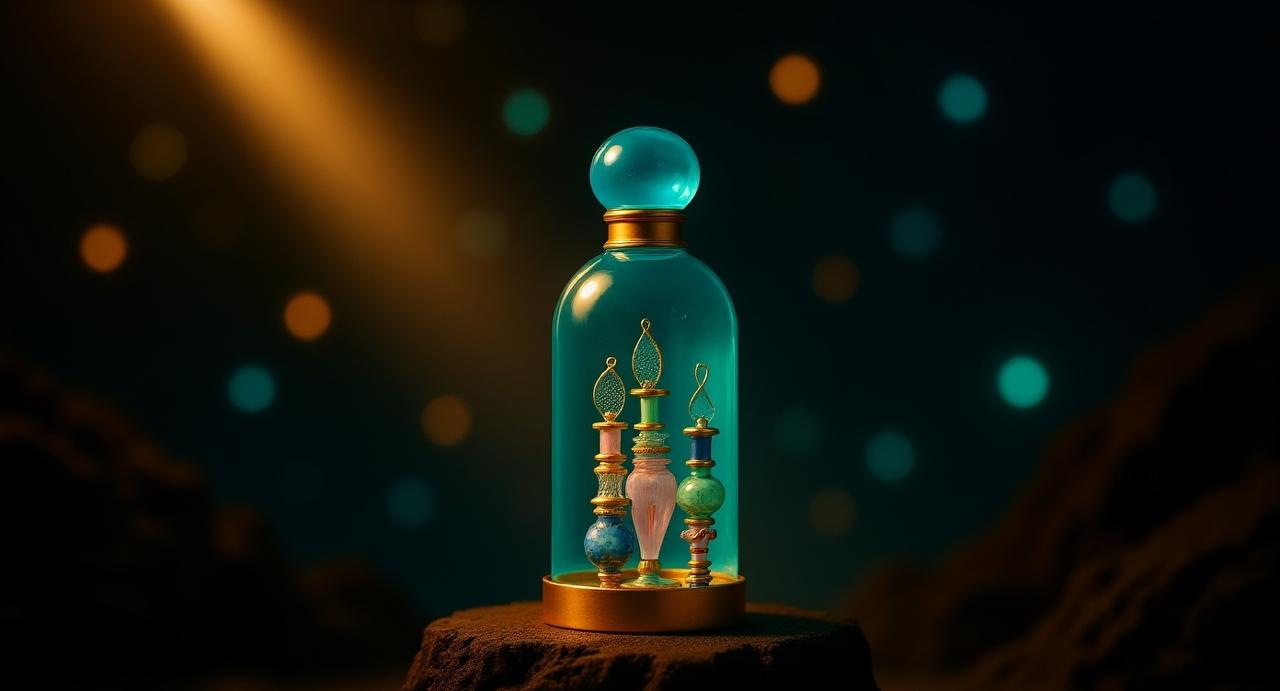
Today our pieces light dinner tables, hold fragrance for perfume houses, and stand in boutiques and hotels well beyond Cairo. Every one of them left the same workshop, made by the same named hands.
One city. One furnace. One unbroken craft.
Read further
Heritage — a thousand years of Cairo glass, and the vocabulary our pieces are named for.
How It's Made — breath, fire and gold, step by step.
The House — the short way in.
Or begin with the pieces: Candlelight · The Perfume Atelier · Vases & Decor · Gifting
Glass breathed in Cairo.